
A Costly Lesson in Substantiation
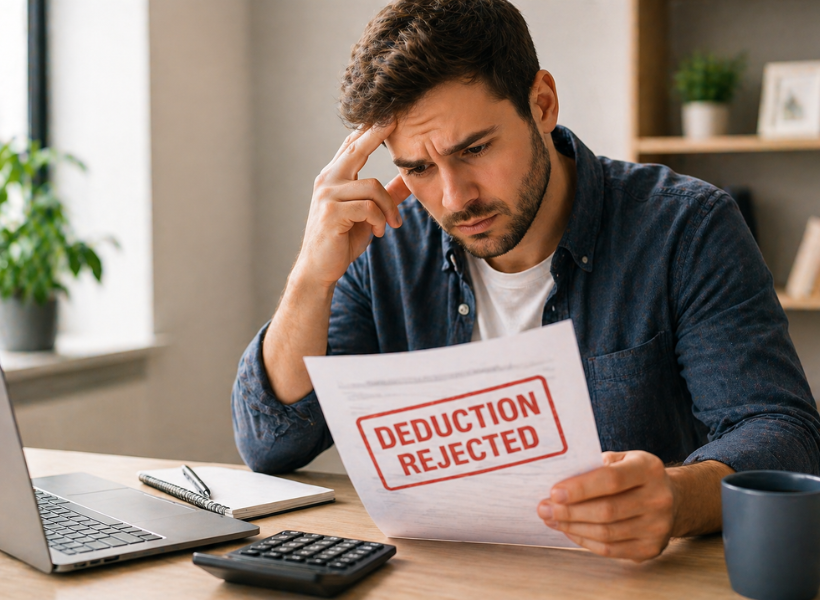
In February 2026, the Administrative Review Tribunal (ART) handed down a decision that should serve as a clear warning to every Australian employee who claims work-related deductions at tax time. A full-time engineer working under a hybrid arrangement claimed over $61,000 in work-related deductions for the 2023 income year. The ATO audited his return, disallowed the vast majority of those claims, and the ART upheld the ATO’s decision in almost every respect.
The reason? Not that the expenses were necessarily illegitimate in nature. The problem was that the taxpayer could not adequately substantiate them.
This case is not an anomaly. It is a textbook illustration of what the ATO looks for when it reviews deduction claims, and it demonstrates exactly how quickly a large deduction claim can collapse when the supporting records are not in order.
Who Was the Taxpayer and What Did He Claim?
The taxpayer was a full-time engineer employed under a hybrid working arrangement, working from home two days per week. For the 2023 income year, he lodged a tax return claiming deductions totalling over $61,000 across the following categories:
| Deduction Category | Amount Claimed |
| Car expenses | $11,130 |
| Work-related travel (taxi and Uber) | $5,347 |
| Clothing expenses | $1,820 |
| Self-education expenses | $4,513 |
| Interest expenses | $15,407 |
| Other work-related expenses (incl. home office renovations) | $17,726 |
| Home utility expenses | $2,826 |
| Donations | $5,316 |
| Total claimed | $63,085+ |
Following an audit in December 2023, the ATO issued an amended assessment disallowing almost all of these claims. The Commissioner allowed just $1,382 of the $17,726 claimed under “other” work-related expenses, and $68 of the $5,316 in donations. The ATO chose not to apply an additional penalty of $5,034, though it was entitled to do so.
The taxpayer disputed the ATO’s decision in March 2024, arguing that he had not been informed of the required format for submitting supporting documents. Following his objection, the Commissioner allowed a further $129 in travel expenses and $779 in work-related expenses in December 2024. The ART then heard the matter and, on 11 February 2026, ruled in favour of the Commissioner across the board, upholding the ATO’s assessment that the deductions could not be substantiated.
Why the Car Expense Claims Failed
The taxpayer’s role as an engineer required him to conduct site visits, which formed the basis of his car expense claims. He used the logbook method to calculate his business-use percentage and claimed $11,130 in car expenses for the year.
The ART disallowed the claim for two key reasons, both of which are directly relevant to anyone using the logbook method:
- The logbooks were not contemporaneous. Under Australian tax law, a valid logbook must be kept in real time, meaning entries must be recorded at the time of travel, not reconstructed afterwards from memory or other records. The ART found that none of the taxpayer’s logbooks met this requirement. According to the ATO’s logbook requirements page, a logbook entry must record the date of each journey, its start and end time, the odometer readings at the start and end, the kilometres travelled, and the purpose of the journey. Reconstructing this information after the fact does not satisfy the legislative requirements.
- The logbook entries were inconsistent with independent records. The ART noted that the logbook entries contradicted other objective records, specifically car service records, which documented the vehicle’s actual usage and odometer readings. When a taxpayer’s self-maintained records conflict with independent third-party records, the tribunal will give weight to the independent records, and the taxpayer’s claim will almost certainly fail.
- Some expenses had already been reimbursed by the employer. A claim cannot be made for expenses that the employer has already reimbursed. The ATO identified that some of the car expenses claimed had already been covered by the employer, meaning no out-of-pocket cost existed for the taxpayer to claim.
Why the Travel Expense Claims Failed
The taxpayer claimed $5,347 in work-related travel expenses, largely covering taxi and ride-share (Uber) fares. The ART identified two specific problems with this category of claim:
- No clear separation of reimbursed versus unreimbursed travel. The taxpayer did not provide evidence that clearly identified which travel expenses had already been reimbursed by his employer. Without this separation, it was impossible to determine what portion, if any, represented a genuine out-of-pocket expense eligible for a deduction.
- The ride-share documentation was inadequate. For the Uber fares, the taxpayer provided ride-share receipts. However, the ART found those receipts did not include the date, time, or destination of travel. Without this basic information, there is no way to establish that the journeys were undertaken for a work purpose rather than a personal purpose. The ATO’s general guidance on work-related travel expenses is clear: you need documentary evidence that connects each expense to a work purpose.
Why the Home Office and Utility Claims Failed
This element of the case is particularly relevant given the number of Australians who have been working from home under hybrid arrangements in recent years.
The taxpayer claimed $2,826 in home utility expenses, representing approximately 70% of his household’s total utility bill. He also claimed part of his “other” work-related expenses for renovations to his home office.
The ART found two significant problems:
- No documentary evidence supporting the expenses themselves. The taxpayer provided calculations estimating his business-use proportion of utility costs. However, he did not provide documentary evidence that the underlying expenses actually existed, for example, actual electricity or internet bills. Calculations without underlying evidence are not sufficient. Under the ATO’s working from home expenses guidance, whether you use the fixed rate method or the actual cost method, you must hold records of the actual expenses incurred.
- The apportionment was not fair and reasonable. Even setting aside the missing documentary evidence, the ART was not satisfied that claiming 70% of the entire household utility bill as a work-related expense was a fair and reasonable apportionment for someone working from home two days per week. An appropriate apportionment must reflect the actual proportion of usage that is genuinely work-related, and a claim that captures such a large share of household expenses for a part-time work-from-home arrangement will face significant scrutiny.
Why the Clothing Claims Failed
The taxpayer claimed $1,820 for clothing expenses. Under Australian tax law, clothing is only deductible if it falls into specific categories: it must be a compulsory uniform, a registered non-compulsory uniform, occupation-specific clothing that is not suitable for everyday wear, or protective clothing that guards against the risk of injury or illness.
General work attire, even if purchased specifically to wear to work, is not deductible. The ATO’s clothing, laundry and dry-cleaning expenses page is explicit on this point. Without evidence that the claimed clothing met one of these specific categories, and with no receipts or other supporting documentation provided, the claim was disallowed in full.
The Taxpayer’s Defence and Why It Did Not Work
The taxpayer argued in his objection that he had not been informed of the required format in which documents needed to be submitted. He wrote: the confusion arose because he was unaware of specific requirements regarding the format in which documents needed to be provided.
The ART did not accept this as a valid reason for the failure to substantiate. The obligation to keep records and retain documentary evidence for work-related expense claims is not triggered by a request from the ATO. It is an ongoing legal obligation that exists from the moment an expense is incurred. Taxpayers are required to keep records for at least five years from when a return is lodged, and those records must be adequate to support the claims made.
Claiming that you did not know the requirements, or that you could not locate your records when asked, does not discharge the substantiation obligation.
The Three Golden Rules of Work-Related Deductions
The ATO applies three core tests to every work-related deduction claim. All three must be satisfied:
Rule 1: You must have spent the money yourself and not been reimbursed. If your employer has paid for or reimbursed the expense, you have not incurred a cost and cannot claim it. This caught the engineer on both his car and travel claims.
Rule 2: The expense must be directly related to earning your income. There must be a direct connection between the expense and your income-earning activities. General expenses, private expenses, or expenses incurred to improve your overall employability (rather than your current role) generally do not qualify.
Rule 3: You must have a record to prove it. For total work-related expense claims above $300, written evidence is required for every claim. This means tax invoices, receipts, bank statements, or other documentary evidence. Estimates, calculations, or verbal explanations are not sufficient.
The ATO’s three golden rules page explains these requirements clearly, and they apply equally to all employees regardless of occupation or income level.
Key Takeaways: What Every Employee Should Do
This case provides very clear guidance on what good record keeping for work-related deductions looks like in practice:
For car expenses: Keep a contemporaneous logbook that is updated at the time of every work journey. Ensure the entries are consistent with your vehicle’s service history and odometer records. Never reconstruct a logbook from memory after the fact.
For travel expenses: Keep every receipt or electronic record from ride-share and taxi services, and ensure each record shows the date, time, start point, and destination. Maintain a log that matches each journey to a specific work purpose, and clearly separate any expenses that were reimbursed by your employer.
For home office expenses: Keep your actual utility bills and internet invoices. Calculate your business-use percentage based on a method that is demonstrably fair and reasonable given your actual working pattern. Two days per week from home is a roughly 40% work-from-home arrangement, meaning a 70% household utility claim is very difficult to justify.
For clothing: Only claim items that meet the specific ATO categories for deductible clothing. Keep receipts and, if the clothing carries a logo or constitutes a uniform, keep documentation confirming it is compulsory or registered.
For all claims above $300 in total: Written evidence is mandatory, not optional.
A Note on the $300 Threshold
There is a common misconception that you can claim up to $300 in work-related expenses without any documentation. This is not accurate. If your total work-related expense claims for the year exceed $300, you must have written evidence for every dollar claimed, not just the amount above $300. The $300 threshold is an exception from the written evidence requirement only when your total work-related claims are below that amount.
How JMB Consultants Can Help
Work-related deductions are one of the most common areas where Australian employees either over-claim and face ATO scrutiny, or under-claim and miss out on legitimate entitlements. At JMB Consultants, we can help you:
- Review your deduction claims to ensure they are legitimate and properly substantiated
- Set up a record-keeping system that captures the evidence you need throughout the year
- Advise on which expenses qualify and how to calculate apportionment fairly
- Respond to ATO audit or review queries about prior year deduction claims
Contact us before you lodge your next tax return to make sure your deduction claims are built on solid ground.
The information in this blog is general in nature and does not constitute personal tax advice. Please seek professional advice to confirm how these rules apply to your specific circumstances.