
The Logbook Is Where Most Car Claims Fall Apart
Car expenses are one of the largest deductions many Australian employees and sole traders claim each year. They are also one of the most frequently challenged by the ATO. And when a car expense claim does get challenged, the logbook is almost always at the centre of the dispute.
The ART case we examined in Blog 6 demonstrates exactly how this plays out. A full-time engineer claimed $11,130 in car expenses for the 2023 income year. The ATO disallowed the claim in full. The ART upheld that decision, citing two clear failures: the logbooks were not contemporaneous, meaning they were not recorded in real time at the time of travel, and the logbook entries contradicted independent car service records. The claim did not survive scrutiny because the records did not hold up.
If you use your car for work and want to claim car expenses, this blog explains the two methods available, what a valid logbook actually requires, the mistakes that get claims rejected, and what the ATO looks for when it reviews your records.
Which Method Should You Use?
There are two methods for claiming car expenses in Australia. The right one depends on your circumstances, how far you drive for work, and what kind of records you are willing to keep.
Method 1: Cents Per Kilometre
The cents per kilometre method is the simpler option. For the 2024-25 and 2025-26 income years, the rate is 88 cents per kilometre.
Key features of this method:
- You can claim a maximum of 5,000 work-related kilometres per car.
- The rate covers all car running expenses, including registration, fuel, servicing, insurance, and depreciation. You cannot claim any of these separately on top of the cents per kilometre amount.
- You do not need to keep every receipt, but you do need to be able to explain how you calculated your work-related kilometres. A diary, calendar, or work schedule is the typical form of supporting evidence.
When is this method best?
The cents per kilometre method suits people who drive moderate distances for work and want a simple calculation without detailed record keeping. The maximum deduction under this method for 2025-26 is $4,400 (5,000 km x 88 cents). If your actual car costs are higher than this, or if you drive more than 5,000 work kilometres in the year, the logbook method will likely give you a larger deduction.
Method 2: The Logbook Method
The logbook method allows you to claim the work-related use percentage of your total actual car expenses for the year. There is no kilometre cap under this method, which makes it significantly more valuable for people who drive extensively for work or who have high car running costs.
Under the logbook method, you can claim the work-related portion of:
- Fuel and oil
- Servicing and repairs
- Registration
- Insurance
- Interest on a car loan
- Lease payments
- Decline in value (depreciation) of the car
The work-related percentage is determined by your logbook. This is where the detail and the compliance risk sit.
What a Valid Logbook Actually Requires
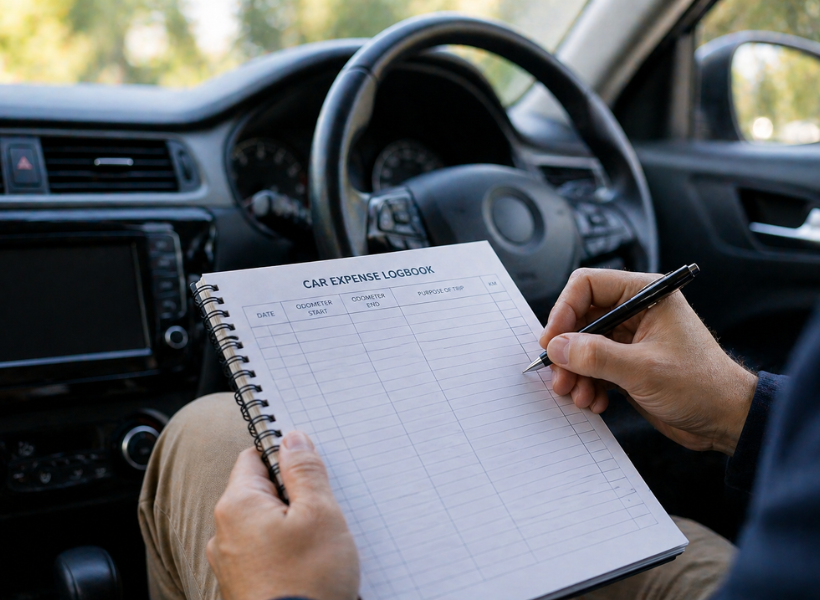
A logbook is not just a rough note of where you drove. It is a formal record that must satisfy specific legislative requirements to be accepted by the ATO. For each journey recorded, your logbook must include: the reason for the journey, the start and end date, start and end odometer readings, and the total kilometres travelled for that trip.
In addition to the per-journey entries, your logbook must also record:
- The make, model, engine capacity, and registration number of the car
- The odometer readings at the start and end of each income year, you rely on the logbook
- The total business-use percentage calculated for the logbook period
If this is the first year you have used the logbook method, you must keep a logbook for at least 12 continuous weeks during the income year, and that 12-week period needs to be representative of your travel throughout the year.
Each logbook you keep is valid for five years, but you may start a new logbook at any time. If your circumstances change, such as a change in the type of work you do or a significant change in your working pattern, you may need to start a new logbook.
You must retain your logbook and odometer records for five years after the end of the latest income year that you rely on them to support your claim.
The Most Critical Rule: Contemporaneous Record Keeping
The single most important requirement for a valid logbook is that entries must be made at the time of travel, not reconstructed from memory or other records afterwards.
This is exactly what went wrong in the ART case. The tribunal found that none of the engineer’s logbooks were contemporaneous. They appeared to have been compiled after the fact, and when the entries were compared against independent car service records showing the vehicle’s actual odometer history, the inconsistencies were significant enough to make the entire logbook unreliable.
The ATO’s guidance on the logbook method is unambiguous on this point. A logbook that is written up at the end of the week, month, or year from rough notes does not satisfy the requirement. A logbook that is reconstructed from a work calendar or GPS records after the ATO requests it definitely does not satisfy the requirement.
The contemporaneous rule means: you record each journey in your logbook at the time of making that journey or immediately after you arrive at your destination. Not on Friday afternoon for the week. Not at the end of the month. At the time.
How to Calculate Your Business-Use Percentage
Your percentage of work-related use is worked out by dividing the work-related kilometres by the total kilometres you travelled in the logbook period.
For example, using the calculation from the ATO’s own worked example:
- Total kilometres in 12-week logbook period: 11,000 km
- Work-related kilometres in that period: 6,600 km
- Business-use percentage: 6,600 ÷ 11,000 x 100 = 60%
You then apply that 60% to your total actual car expenses for the full income year to arrive at your deductible amount.
Once you have an established logbook percentage, you can use it for up to five years without keeping a new 12-week logbook, provided your circumstances have not changed significantly. You must, however, maintain odometer readings at the start and end of each income year you rely on the logbook.
What Happens If the Logbook Period Is Not Representative?
The ATO requires that your 12-week logbook period be representative of your typical annual travel pattern. If you keep your logbook during an unusually busy period of work travel, you will end up with an inflated business-use percentage that does not reflect your actual year-round use of the vehicle.
If your work travel varies significantly across the year (for example, you do a lot of site visits during certain seasons but work primarily from an office during others), you should choose a 12-week period that fairly represents the whole year, or consider whether keeping a full-year contemporaneous record would produce a more accurate and defensible result.
Trips You Can and Cannot Claim
Understanding which trips count as work-related is just as important as keeping a valid logbook. Many taxpayers include trips in their logbook that are not actually deductible, which inflates their business-use percentage and creates audit risk.
Trips you CAN claim:
- Travelling between two separate workplaces on the same day (for example, from your main office to a client’s site)
- Travelling from your workplace to a client meeting, job site, or work-related appointment
- Travelling from your home directly to an alternative workplace that is not your regular workplace (this is a narrow exception with specific conditions, see the ATO’s trips you can and cannot claim page)
- Carrying bulky equipment that cannot be stored at your workplace (subject to specific conditions)
Trips you CANNOT claim:
- Travelling from home to your regular workplace. This is private travel, regardless of how early you leave or how late you return.
- Travelling from your regular workplace to home at the end of the day
- Stopping for personal errands during a work trip (the personal portion of that trip is not deductible)
- Any travel that your employer has reimbursed or for which you receive an allowance that is not included in your assessable income
The home-to-work rule catches a lot of people out. The ATO is unequivocal: travelling between your home and your place of business is considered private use. Recording these trips in your logbook as work-related inflates your business-use percentage and is a common audit trigger.
Evidence You Need Beyond the Logbook
The logbook establishes your business-use percentage, but it does not stand alone. To support a logbook method claim, you also need:
- Receipts for all car expenses other than fuel: servicing invoices, insurance renewal, registration papers, loan or lease documents
- Fuel records: either actual receipts or odometer records from which you can make a reasonable estimate of fuel costs
- Depreciation records: documentation supporting the cost of the car and the depreciation calculation, noting that the car limit of $69,674 applies for the 2025-26 income year
You must keep all of these records for five years from the date you lodge the relevant tax return.
The Car Limit and Its Effect on Depreciation Claims
If you purchased a car for work use, the amount you can use to calculate depreciation is capped by the ATO’s car limit. For the 2025-26 income year, the car limit is $69,674. This means that even if you paid $90,000 for a vehicle, the cost you use for depreciation calculations cannot exceed $69,674.
This cap applies to passenger vehicles designed to carry fewer than nine passengers and a load of less than one tonne. It does not apply to motorcycles, commercial vehicles, or vehicles specifically designed for a different purpose.
Electronic Logbooks: The Easier Way to Stay Compliant
One of the most practical ways to maintain a contemporaneous logbook is to use the ATO’s myDeductions tool, which is built into the ATO app. The app allows you to record each trip on your phone at the time of travel, capturing the date, start and end locations, kilometres, and business purpose. At the end of the income year, the data can be exported directly into your tax return.
Using the ATO app for logbook recording essentially eliminates the contemporaneous record-keeping problem, because every entry is time-stamped at the moment it is made. If the ATO ever questions your logbook, you have a digital audit trail with timestamps that cannot be retroactively altered.
There are also third-party logbook apps and GPS-based vehicle tracking systems that are accepted by the ATO, provided the records they generate include all the required fields.
How the ATO Checks Your Logbook
When the ATO audits a car expense claim under the logbook method, it does not simply accept the logbook at face value. Common verification steps include:
Cross-referencing with car service records. Service records contain odometer readings at each service date. The ATO compares these against the logbook’s odometer entries for the same dates. Inconsistencies, as seen in the ART engineer case, are a red flag that the logbook may not reflect actual usage.
Checking GPS and phone data. The ATO can request location data from phones and GPS devices to verify that recorded trips actually took place.
Reviewing employer records. The ATO can check your employment records, roster, and expense reimbursements to confirm which trips were work-related and which were already reimbursed.
Assessing the reasonableness of the business-use percentage. If you claim 90% business use but your employment contract shows you work in an office five days a week with occasional site visits, the ATO will probe whether that percentage is realistic.
Common Logbook Mistakes That Get Claims Rejected
Based on the ART case and ATO compliance guidance, these are the most frequent logbook errors that result in claims being disallowed:
- Retrospective reconstruction. Writing up the logbook at the end of the quarter or year, rather than recording trips in real time. This is the most common and most damaging error.
- Inconsistency with independent records. Odometer readings in the logbook that contradict car service records, roadside assistance records, or GPS data.
- Including home-to-work trips. Recording daily commutes as work-related travel. These trips are never deductible for employees.
- Missing purpose descriptions. Recording only the destination without describing the business reason for the trip. “Client site” is better than “123 Smith Street.” “Quarterly audit review at client’s office” is better still.
- Using an expired logbook without updating odometer records. A five-year-old logbook is still valid if your circumstances have not changed, but you must record the odometer readings at the start and end of every income year you rely on it. Forgetting to do this can invalidate the logbook for that year.
- Claiming reimbursed expenses. Including in your claim expenses for trips or costs that your employer has already reimbursed.
Side-by-Side Method Comparison
| Cents Per Kilometre | Logbook Method | |
| Rate / basis | 88c per km (2025-26) | Actual expenses x business-use % |
| Kilometre cap | 5,000 km maximum | No cap |
| Maximum deduction (at cap) | $4,400 | No limit |
| Records required | Work-related km records | 12-week contemporaneous logbook, all receipts, odometer records |
| Includes depreciation? | Yes (built into the rate) | Yes (claimed separately) |
| Best suited to | Lower actual costs, simpler records | Higher actual costs, extensive work travel |
A Practical Logbook Checklist
Use this checklist to confirm your logbook satisfies ATO requirements:
- Every entry was recorded at the time of each trip, not reconstructed later
- Each entry includes the date, start and end odometer reading, kilometres travelled, and the business reason for the trip
- The car’s make, model, engine capacity, and registration number are recorded
- The logbook covers a minimum 12-week continuous period that is representative of typical annual travel
- Odometer readings at the start and end of every income year, relying on this logbook, are recorded
- Logbook entries are consistent with independent records, such as car service history
- Home-to-work commutes are excluded from business-use kilometres
- All receipts for fuel, servicing, registration, insurance, and loan payments are kept and filed
How JMB Consultants Can Help
Car expense claims under the logbook method are among the most valuable deductions available to employees and sole traders who regularly use their vehicles for work. They are also among the most scrutinised. At JMB Consultants, we can help you:
- Determine which method gives you the largest deduction for your circumstances
- Review your existing logbook to identify any gaps or inconsistencies before lodging
- Set up a contemporaneous logbook system, including using the ATO app, that produces a defensible record
- Advice on the car limit and depreciation calculation for recently purchased vehicles
- Respond to ATO queries or audit requests about prior year car expense claims
Contact us before you lodge your next return to make sure your car expense claims are accurate, complete, and built on records that will hold up to scrutiny.
The information in this blog is general in nature and does not constitute personal tax advice. Please seek professional advice to confirm how these rules apply to your specific circumstances.